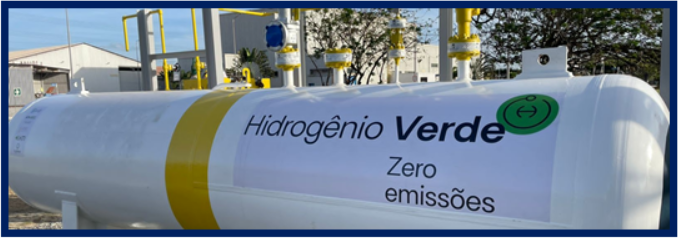
The search for alternative energies to fossil fuels is not recent. Historically, John Burdon Sanderson Haldane was the first to describe the concepts of the hydrogen economy, presenting the topic at the University of Cambridge in 1923. However, it was only in 1990 that the first green hydrogen (H2V) pilot plant was installed by the company Solar-Wasserstoff-Bayern, using solar energy, in Germany.
Hydrogen, considered a low molecular weight fuel, has the highest amount of energy per unit of mass of any element. Hence its crucial importance in energy transition strategies, as it offers an alternative for highly carbon-intensive sectors. This view is even aligned with the report of the United Nations High-Level Political Forum, which identified green hydrogen as a key solution for hard-to-decarbonize sectors.
According to the International Renewable Energy Agency (IRENA), hydrogen is likely to influence the shift in the geography of energy trade. With decreasing costs, the geopolitical landscape is expected to show growing regionalization in energy relations. Furthermore, hydrogen could facilitate the transport of energy produced over long distances via pipelines and/or maritime shipping.
In Brazil, green hydrogen is recognized as an energy solution to fulfill the country’s international commitment to carbon neutrality by 2050. The same understanding was presented in the Intelligence Report “Hydrogen Market Update in Latin America”. According to the document, the country is prepared to assume a prominent role in the global market and become one of the main exporters of the fuel thanks to its abundance of renewable energy sources.
Several indicators show that Brazil has a great opportunity to play an important international role by offering low-cost and high-volume green hydrogen, making it viable in the domestic market and enabling exports to other countries.
In Latin America, the country is in a leading position to become a major exporter of low-carbon hydrogen due to favorable climatic conditions for the generation of electricity from wind, solar, and hydropower. The State of Ceará follows the same trend thanks to its photovoltaic and wind generation potential.
Thus, the ongoing transition from fossil to renewable energies is irreversible, as it represents global commitment to mitigating the effects of global warming. For this, according to IRENA and International Energy Agency (IEA) reports, activities involving new technology development, investment attraction, and long-term actions would necessarily require cooperation among countries.
Based on these considerations, Liberal Theory — a school of thought in International Relations — becomes relevant. In the economic field, it emphasizes free markets, mutual collaboration, and the possibility of interdependence, arguing that institutions, through trade, democracy, and international norms, can better promote cooperation.
Liberalism has its roots in the ideas of philosophers such as Immanuel Kant and John Locke, who advocated governance based on laws, individual freedoms, and the possibility of progress and peace through cooperation. It was also influenced by British philosopher Norman Angell and his 1910 work “The Great Illusion”.
The theory holds that policies among nations would foster economic integration, strengthen international institutions, and enhance cooperation on transnational issues, among other advantages; in the energy field, it would decisively contribute to the decarbonization of the economy. For this, the necessary mutual cooperation between governments and institutions would emerge to overcome the challenges and uncertainties of the global energy transition.
In the specific case of green hydrogen “made in Ceará”, international relations with consumer countries — under the umbrella of Liberal Theory — would be essential for facilitating alliances and positioning the State on the international stage. The clearest example is the existence of agreements and partnerships with Germany, to the point that the German government decided to reopen its diplomatic representation (honorary consulate) in Fortaleza after three years (closed during the Covid-19 pandemic). The decision followed the identification of Ceará’s energy potential and its maritime, air, and digital hubs.
Another highlight is the Federation of Industries of the State of Ceará (FIEC), which has been consolidating several bilateral agreements, such as those with the German Cooperation Agency (GIZ Brazil), investments in the Jurandir Picanço Center of Excellence in Energy Transition (for workforce training), and with the Fraunhofer Institute for research on green hydrogen and carbon credits.
Other promising initiatives for the production and export of green hydrogen — aligned with the principles of Liberal Theory — were the strategic alliances between the Port of Pecém (Ceará) and the Port of Rotterdam (Netherlands), and the ports of Duisport and Rostock in Germany. This synergy tends to contribute to the global energy transition process, making Ceará a true protagonist in the decarbonization of the global economy.
As a result, significant socioeconomic gains would emerge for the population of Ceará. During the launch of the Green Hydrogen Masterplan in Ceará, numerous opportunities within the H2V economy were presented. Economic sectors such as energy, civil construction, heavy construction, and the metal-mechanical industry are expected to become essential in developing the hydrogen value chain, consequently benefiting the State’s economic and social dimensions.
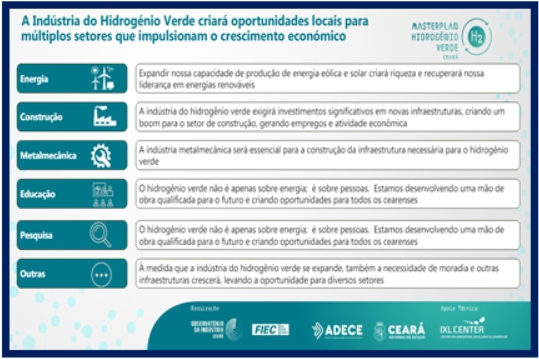
Source: Green Hydrogen Masterplan in Ceará (FIEC; PATEL, 2024).
Another important aspect is the legacy of hydrogen in the educational field, considering the need to train and prepare specialized human resources today, ensuring a more promising future for the people of Ceará.
REFERENCES:
- BUENO, Guilherme. Theory of International Relations: Complete Study Guide 2024. Higher School of International Relations. Published on February 25, 2024.
- Pecém Industrial and Port Complex (CIPP). News. Governor Elmano strengthens partnership with the Port of Rotterdam, one of the most important in the world. Published on Jan. 13, 2025. Available at: https://www.complexodopecem.com.br/governador-elmano-fortalece-parceria-com-o-porto-de-roterda-um-dos-mais-importantes-do-mundo/
- Government of the State of Ceará. Ports of Pecém, Rotterdam and Duisport sign agreement to expand the Green Corridor to Germany. Published on Dec. 12, 2024. Available at: https://www.ceara.gov.br/2024/12/12/portos-do-pecem-rotterdam-e-duisport-assinam-acordo-para-expandir-o-corredor-verde-ate-a-alemanha/
- GRANGEIRO, Alessandra Romano. Green hydrogen hub and new projects at the Pecém Complex. In: 2nd Strategic Studies Conference. Fortaleza, 2025. Available at https://jornadadeenergia.10rm.eb.mil.br/
- International Energy Agency (IEA). The Future of Hydrogen. Paris, 2021.
- International Renewable Energy Agency (IRENA). Geopolitics of the Energy Transformation: The Hydrogen Factor. Abu Dhabi, 2022.
- OLIVEIRA, Rosana Cavalcante de. Overview of Hydrogen in Brazil. Discussion Paper 2787. Institute for Applied Economic Research (IPEA). Brasília, 2022.
- Policy Briefs in Support of the High-Level Political Forum 2022. Addressing Energy’s Interlinkages with Other SDGs. Available at: 2022-UN_SDG7 Brief-060122.pdf.
- PATEL, Hidentra. Green Hydrogen Masterplan in Ceará. FIEC, 2024.
- Foreign Affairs Magazine. Liberalism. Published on Feb. 22, 2024. Available at: https://relacoesexteriores.com.br/glossario/liberalismo/.
- Rotterdam, Port of. Port of Rotterdam Authority signs investment agreement for participation in Port of Pecém. Published on Oct. 25, 2018. Available at: https://www.portofrotterdam.com/en/news-and-press-releases/port-rotterdam-authority-signs-investment-agreement-participation-port
- _________. Green energy from Brazil for Germany. Published on Dec. 15, 2024. Available at: https://www.portofrotterdam.com/en/news-and-press-releases/green-energy-brazil-germany
- The Pen Empowering People. J. B. S. Haldane was an early pioneer for renewable energy. Published on Sept. 29, 2020. Available at: https://shre.ink/gdtG.
- TV SENADO. The final report of COP 28 states that countries must transition away from fossil fuels by 2050 and proposes tripling global renewable energy capacity by 2030. At COP 28, it was also officially announced that Brazil will host COP 30 in 2025. Available at: https://shre.ink/ggph.
- VASILEVA, Anna. Hydrogen Market Updates From Across Latin America. Intelligence Report. World Hydrogen Leaders. Chile, 2023. Available at: http://surl.li/ovcoqf.