
Research presented an overview of hydrogen in Brazil with emphasis on the State of Ceará, which was considered the “First Green Hydrogen Valley in Brazil” for having desirable strategic factors such as renewable energy sources and the geographical location of the Pecém Industrial and Port Complex (CIPP).
The physiographic advantages mentioned above were strengthened when, anticipating by 14 years the Triennial Work Plan of the Ministry of Mines and Energy, Ceará launched its Hydrogen Hub in 2021. The Federation of Industries of Ceará, the Pecém Complex, and the Federal University of Ceará signed a memorandum of understanding for the construction of a hydrogen plant in the CIPP, making this complex (export, port, industrial and logistics) a generator of added value focused on innovation, sustainability and operational efficiency.
To illustrate, the World Bank and the Ministry of Development, Industry, Commerce and Services financed the necessary infrastructure for the development of the hub in the Pecém Complex with USD 100 million. These resources matched studies carried out by the international consulting firm McKinsey, which observed that since Brazil's energy matrix is composed of 85% renewable energy, investments in the production of green hydrogen could benefit from the existing electrical grid, as 70% of the production cost of hydrogen is the cost of energy.
Not by coincidence, in May 2023, the government of Ceará and the Netherlands established the Pecém–Rotterdam maritime corridor, creating an H2V route to Europe. Considered the largest and best port infrastructure in Europe, Rotterdam provides access to a market of 440 million consumers.
This joint venture is considered strategic because Rotterdam is well positioned in the European market, being a port complex that combines production, consumption, import terminals, and a distribution channel to other European countries. This partnership would strengthen bilateral cooperation and promote initiatives for port development and H2V production projects. Rotterdam’s demand for hydrogen in Germany could reach 20 Mton/year by 2050, of which 18 Mton/year would come from imports.
During the World Hydrogen Summit in 2022, it was announced that 4.6 Mton of H2V would be distributed to Europe through the Port of Rotterdam in 2030, of which 4 Mton would be imported and the remainder produced in the port itself. In Pecém, with an estimated production of 1.3 Mton/year in 2030, the CIPP would have the potential to meet 25% of Rotterdam’s import demand.
On this side of the Atlantic, it is highlighted that a competitive advantage of the Hydrogen Hub (CIPP) would be, among others, a free zone (Export Processing Zone), granting differentiated tax incentives, according to Federal Law No. 11.508/2007 and Federal Law No. 14.184/2021. Moreover, the benefits granted to companies installed there would be guaranteed for up to 20 years.
Export Processing Zone (ZPE Ceará): Tax Benefits.
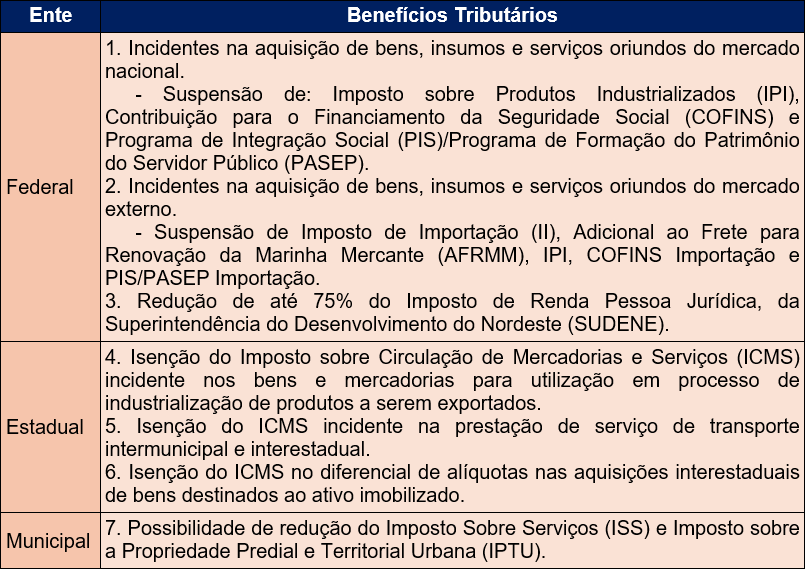
Source: ZPE Ceará.
As industries operate with tax, exchange, and administrative benefits, the incentives mentioned above would stimulate the hydrogen economy, allowing Ceará to become an international hub for production and export to Europe.
Thus, from the aforementioned conditions, measures and actions, it is inferred that the State of Ceará has the potential to become a global protagonist in the energy transition (production, distribution and export of H2V), contributing to reducing global CO2 levels and to the socioeconomic, technological and environmental development of the state.
REFERENCES:
- BEZERRA, Francisco Diniz. Banco do Nordeste. Industry. Green Hydrogen: Opportunity for the Northeast. ETENE Sectoral Report. Year 8. No. 320. Dec. 2023.
- Federation of Industries of the State of Ceará. Green Hydrogen Hub is launched in Ceará with the partnership of FIEC. Available at: https://www1.sfiec.org.br/sites/numa/?st=noticia&id=139592.
- FIGUEIRÊDO, Hugo. CIPP. Energy Transition and Green Hydrogen Production Seminar. Opportunity to Transform the Economy of Ceará and Brazil through the Green Hydrogen Hub in Pecém. Published on Oct 06, 2023.
- Konrad Adenauer Foundation. Cooperation between Brazil and Europe: geopolitical importance and innovation prospects. Brazil-Europe Relations Series No. 12. Rio de Janeiro, 2022.
- Government of the State of Ceará. Ceará State Development Agency (ADECE). Ceará Wind and Solar Atlas. Fortaleza, 2019. Available at: http://atlas.adece.ce.gov.br/.
- _______. Secretariat of Economic Development and Labor. Green Hydrogen in Ceará. Available at: https://www.sedet.ce.gov.br/wp-content/uploads/sites/15/2021/07/Proposta_Apresentação-Institucional-Hidrogênio-Verde-Ceara.pdf
- _______. Secretariat of Infrastructure. ADECE. Renewable Energies of Ceará. Available at: https://shre.ink/gB6U.
- MCKINSEY & COMPANY. Green hydrogen: an opportunity for wealth generation with sustainability for Brazil and the world. Published on Nov 25, 2021.
- Ministry of Mines and Energy. National Hydrogen Program. Triennial Work Plan 2023-2025. Brasília, 2023.
- OLIVEIRA, Rosana Cavalcante de. Hydrogen Outlook in Brazil. Discussion Paper 2787. Institute for Applied Economic Research (IPEA). Brasília, 2022.
- Port of Rotterdam. Ports of Rotterdam and Pecém (Brazil) join Brazilian-Dutch cooperation. Published on May 11, 2023. Available at: https://shre.ink/gBKQ
- RACCICHINI, Andrea; CONTARDI, Marco; RISTUCCIA, Marco Saverio. Getúlio Vargas Foundation (FGV). FGV Europe. Innovative Energy Climate Action. Part 4: The Brazilian Hydrogen Move, 2022.
- URIBE, Duna. Port of Rotterdam as a gateway to Northwest Europe for the Brazilian H₂ Market. World Hydrogen Summit, 2024.
- VASILEVA, Anna. Hydrogen Market Updates From Across Latin America. Intelligence Report. World Hydrogen Leaders. Chile, 2023.
- Export Processing Zone (ZPE Ceará). Benefits. Available at: https://zpeceara.com.br/beneficios/