
A detailed study of geographic spaces can provide various information that, if well used, would allow political, economic, social, and military decisions to be better made toward a specific goal. Doctrinally, the physiographic factors of the terrain are divided into: area characterization (surface, shape, position, and borders), geology, relief, hydrography, coastline, climate, and vegetation.
And in the State of Ceará? Which factors would give it competitive advantages in the production and export of Green Hydrogen (H2V)? In this case, it is believed that position, relief, coastline, and climate (temperature and wind) offer differentiated conditions that positively and directly influence the development of the H2V economy.
In terms of position, it is analyzed based on latitude, proximity or distance from the sea, altitude (plain, plateau, or mountains), and its relation to neighboring regions. In this case, Ceará occupies the northeastern portion of Brazil at a latitude of 4°46'30'' South. Being close to the Equator, the incidence of solar rays is almost perpendicular to the surface, allowing temperatures to be higher compared to higher latitudes.
Because it is entirely within the Brazilian solar belt, which stretches from the Northeast to the Pantanal, it benefits from optimal irradiation rates, favoring the exploitation of photovoltaic solar energy. Indeed, the Wind and Solar Atlas of Ceará proves how its geographic position enables economic exploration of this energy, generating a photovoltaic potential of 643 GW.
Located in the Northeastern Salient, its position is strategic as it shortens distances to the European continent, lies close to important maritime routes and consumer markets, and facilitates access to major international flows of products, goods, and services.
Regarding maritime influence, it is bathed by the Atlantic (an ocean of great global importance and Brazil’s main economic artery), facilitating commercial exchange. It is also noteworthy that Ceará’s continental shelf (a geological extension of continental land, up to a depth of 200 meters) provides favorable land–sea articulation conditions, i.e., suitable points for establishing and building ports, such as the one in the Pecém Industrial and Port Complex (CIPP).
Regarding altitude, plains have always facilitated human circulation and land exploitation. In Ceará’s case, in the north are the coastal plains along the Atlantic, with elevations ranging from 30 to 100 meters, increasing as one moves inland. Not by chance, the combination of position, altitude, and wind factors allowed the installation and operation of several wind farms on Ceará’s coastal plains.
Location of some wind farms in the State of Ceará (coastal plain).
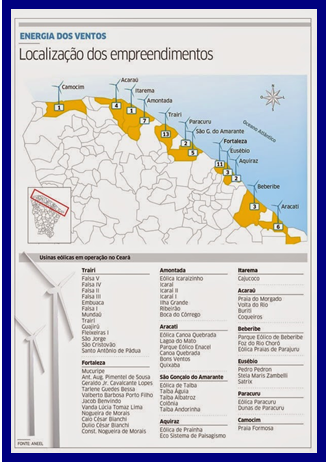
Source: Litoral Leste Magazine (2014).
According to the Brazilian Wind Energy Association, the Northeast is responsible for 85% of all electricity generation from wind. Of the 534 wind farms in the country, 430 are located in the Northeast, with the State of Ceará ranking fourth in wind generation (7.06 TWh) in 2022. Added to this is an area with continuous trade winds intensified by sea breeze.
These conditions resulted from various studies that favored wind farm installation based on statistical, technical, and financial feasibility criteria using the Weibull probability distribution, which is applied in studies estimating energy potential through wind speed.
Thus, the combination of high solar irradiation with winds along the Atlantic coast favors Ceará as a potential H2V producer whose competitiveness in production costs would make it a global player in the hydrogen economy, as it already has an electricity matrix marked by renewable energy sources.
The characteristics above align with the International Renewable Energy Agency (IRENA), which states that H2V will be most economically produced in locations that combine abundant renewable resources, available land, access to water, and capacity to transport it to major importing countries.
And studies by the National Bank for Economic and Social Development indicate that the main factors influencing H2V production costs include, among others, the cost of acquiring renewable electricity used in the production process.
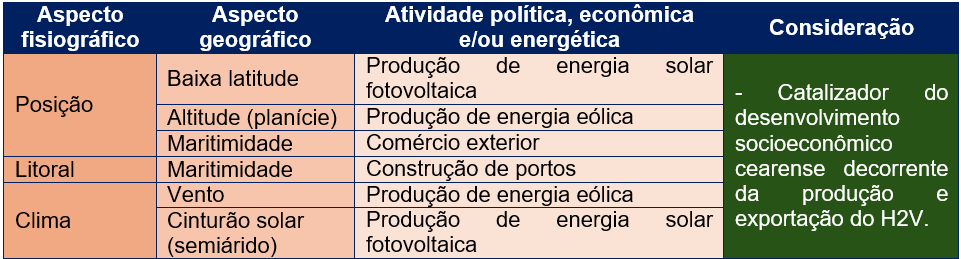
Thus, it is concluded that the geographical position of the State, combined with climatic conditions (temperature and winds), allows it to be a promising generator of photovoltaic and wind energy thanks to what is called energy complementarity, providing more attractive and competitive operational, logistical, and commercial advantages.
Therefore, based on the analyses presented, the State of Ceará, thanks to its physiographic conditions, could become a potential energy supplier to Europe over other producing countries, allowing it to transform its potential into economic–energy power.
REFERENCES:
- ALBUQUERQUE, Edu Silvestre de. The insertion of the Northeastern Salient into the global economy and its geostrategic importance in national defense: the case of the Natal Choke Point. Porto Alegre, 2018.
- Brazilian Association of Wind Energy and New Technologies (ABEEólica). Annual Bulletin 2022.
- National Bank for Economic and Social Development (BNDES). Low-carbon hydrogen: opportunities for Brazil’s leadership in clean energy production. Rio de Janeiro, 2022.
- CASTRO, Tiago Castro de. Geographic Spaces. Study Systematics. 2nd ed. Brazilian Army Library. Rio de Janeiro, 1994.
- CAVALCANTE, José Ricardo Montenegro. Green Hydrogen and Renewable Energies: The Ceará Opportunity. In: II Meeting of the Northeast Network of Strategic Studies and Innovation. FIEC, Brazilian Army, Fortaleza, 2023.
- Federation of Industries of the State of Ceará. New Wind and Solar Atlas of the State of Ceará. Master Plan.
- _______. The winds blow in favor of Ceará. Year XIV, nº 152, 2023.
- _______. The future of Pecém is green. Year XV, nº 157, 2023.
- Government of the State of Ceará. Secretariat of Economic Development and Labor. Development Agency of the State of Ceará (ADECE). Fortaleza, 2019. Wind and Solar Atlas of Ceará.
- _______. Infrastructure Secretariat. ADECE. Renewable Energies of Ceará.
- International Renewable Energy Agency (IRENA). Geopolitics of the Energy Transformation – The Hydrogen Factor. Abu Dhabi, 2022.
- MAFRA, Roberto Machado de Oliveira. Introduction to the Study of Geopolitics. Department of Studies. Superior School of War. Rio de Janeiro, 2002.
- MATTOS, Carlos de Meira. Brazil: Geopolitics and Destiny. Brazilian Army Publishing House. Publication 452. Volume 131. Rio de Janeiro, 1975.
- _______. Geopolitics and the Projections of Power. Brazilian Army Publishing House. Publication 472. Volume 152. Rio de Janeiro, 1977.
- OLIVEIRA, Rosana Cavalcante de. Overview of Hydrogen in Brazil. Discussion Paper 2787. Institute for Applied Economic Research (IPEA). Brasília, 2022.
- Solar Portal. How to capture solar energy: everything you need to know.
- Revista Litoral Leste. Aquiraz | Beberibe | Aracati: State gains reinforcement of 136 MW of wind source. Published on Dec 13, 2014.
- SILVA, Franscisco Jeandson Rodrigues da; et al. Shape and scale factors of the Weibull probability distribution: a case study for wind resource data in the Northeast Region of Brazil. Journal of Engineering and Technology, v. 12, n. 1, Apr. 2020.