
Source: UNICEF.
In 1999, the United Nations Security Council approved Resolution S/RES/1261, placing the issue of children affected by armed conflicts on the “maintenance of international peace and security” agenda. At the time, it defined the six grave violations that most affect them in times of conflict: killing and maiming, recruitment, attacks on schools or hospitals, rape or other forms of serious sexual violence, abduction, and denial of humanitarian access.
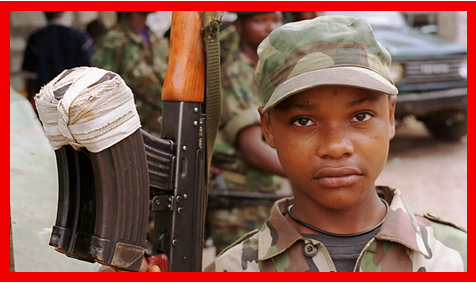
It was estimated that, in the previous decade, about 300,000 children had been recruited by armed groups, with 40% of them on the African continent. Some reasons for this were related to the understanding that children are more obedient and fearless, in addition to being used not only as combatants but also in other activities within armed groups and forces.
Thus, in an environment of great violence directly impacting children’s living conditions, the international community was convinced to promote the adoption of mechanisms and legal tools of international scope. In order to provide better conditions for protecting them, especially those in armed conflicts, governments, institutions, international organizations, among others, proposed to adopt legislation for this purpose.
The reasons for this lie in the fact that civilian casualties increased to such an extent that 90% of deaths in armed conflicts in the first decade of the 21st century were civilians, with a significant number of children.
According to former UN Secretary-General Ban Ki-moon, the forced recruitment and use of children as soldiers is one of the most frightening human rights abuses in the world. Thousands of children were being exploited, forced to endure and inflict violence—something no child should ever experience. Added to this is that all of them suffer various abuses, triggering physical and psychological disorders such as post-traumatic stress and depression.
Historically, in 1924, the League of Nations, predecessor of the United Nations, approved the Geneva Declaration on the Rights of the Child. With only five articles, the Declaration presented the essential rights for childhood development, such as food, health, protection in emergency situations, and protection from all forms of exploitation and abuse. The Declaration demonstrated a growing concern for human rights, recognizing that an individual in development with specific needs deserved the support of international norms.
After World War II (1939–1945), marked by the deaths of millions of civilians, another legal milestone of great global importance was the adoption of the Universal Declaration of Human Rights (UDHR) in 1948 by the United Nations General Assembly (UNGA), establishing fundamental and universally protected rights.
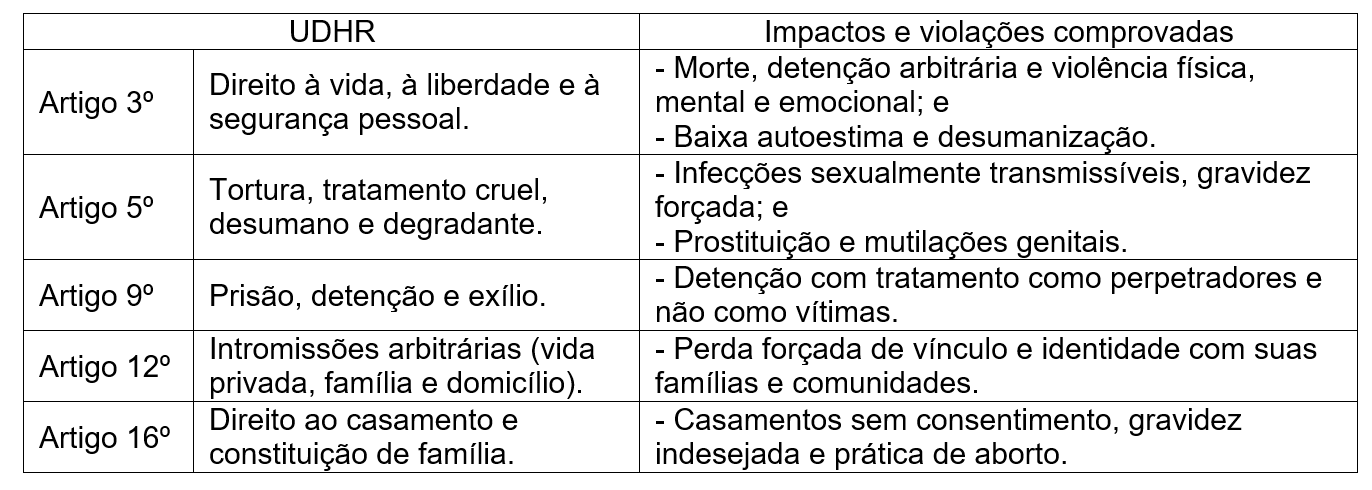
In the 21st century, when observing violations and abuses in contemporary armed conflicts, it becomes clear that the UDHR has greatly contributed to the international legal framework related to children's human rights. In this regard, Table 1 indicates some provisions (on the left) that are directly related to human rights violations against children in armed conflicts (on the right):
Table 1: Violations committed against children in light of the UDHR.
Another legal milestone that contributed to the protection of children in armed conflicts occurred in 1959 when the Declaration of the Rights of the Child was promulgated. Like the Geneva Declaration, it is not legally binding; however, it emphasized rights to protection, education, health, and a nurturing environment. Composed of ten principles, it served as a fundamental document for the subsequent development of national legislation and policies worldwide, guiding efforts to promote children’s rights in diverse contexts.
Regarding armed conflicts, Table 2 shows how human rights violations against children contradict the principles of the 1959 Declaration.
Table 2: Impacts and violations against children in armed conflicts in light of the 1959 Declaration.
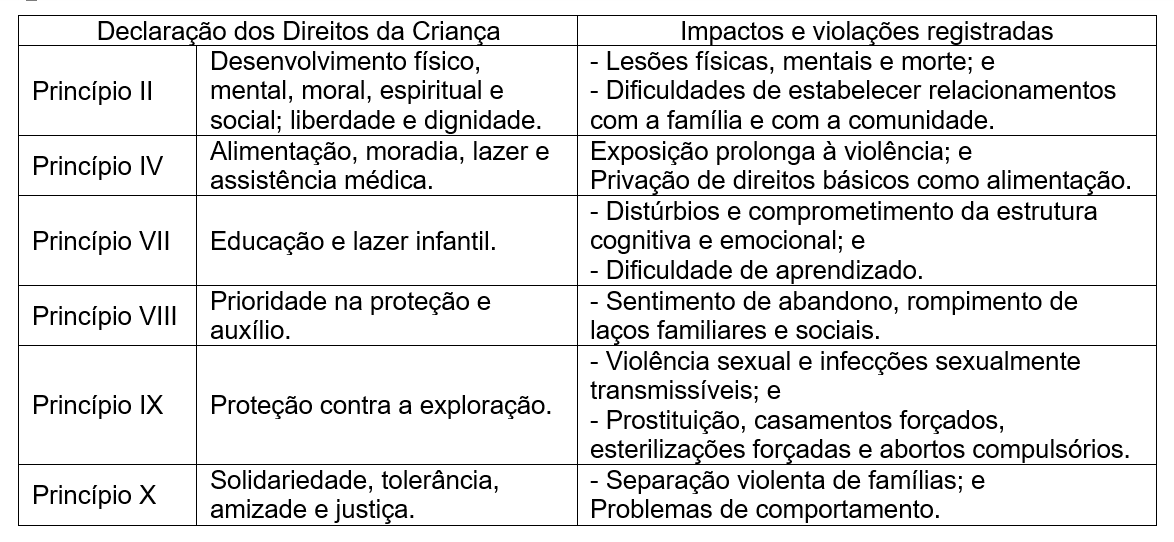
Thus, numerous violations of children’s rights in the context of armed conflict are observed, all of which are addressed in the Geneva Declaration, the Universal Declaration of Human Rights, and the Declaration of the Rights of the Child, showing how these three international legal frameworks converge on the issue of children affected by armed conflicts.
In addition to the aforementioned norms, the international community adopted other instruments, such as International Human Rights Law, International Humanitarian Law, International Criminal Law, and International Refugee Law. In all these norms, the theme “Children in Armed Conflicts” was included to ensure the protection, respect, and promotion of the human rights of boys and girls affected by armed violence.
REFERENCES:
- AGUILAR, Sergio Luiz Cruz; GUERRA, Maria Eduarda. Justiça, Responsabilização e Reconciliação: Os Casos das Crianças Soldados nos Conflitos Armados da Libéria, Serra Leoa e Uganda. Revista Eletrônica Direito e Política, 2022.
- CUNHA, Beatriz Antonello. O impacto psicossocial e os desafios de reintegração de crianças-soldado na República Democrática do Congo. 2024.
- JÚNIOR, Bóia Efraime. Trauma e migração: os traumas psíquicos das crianças soldado. Revista Diversitas, p. 111-130, 2013.
- KADIR, Ayesha; SHENODA, Sherry; GOLDHAGEN, Jeffrey; PITTERMAN, Shelly. American Academy of Pediatrics. The Effects of Armed Conflict on Children, 2018.
- Office for the Coordination of Humanitarian Affairs (OCHA). OCHA (2016). 17º MIMIONU. O direito humanitário em conflitos armados. Disponível em: https://17minionuocha.wordpress.com/2016/08/04/recrutamento-infantil-e-o-dia-da-mao-vermelha/
- Office of the High Commissioner for Human Rights (OHCHR). Universal Declaration of Human Rights, 2000. Disponível em: https://www.ohchr.org/en/universal-declaration-of-human-rights
- Peace Operations Training Institute (POTI). Child Protection for UN Military. USA, 2025.
- PLANTE, Jennifer. The Children of War. Human Rights & Human Welfare. University of Denver, 2008.
- SHENODA, Sherry, KADIR, Ayesha; PITTERMAN, Shelly, GOLDHAGEN, Jeffrey. American Academy of Pediatrics. The Effects of Armed Conflict on Children, 2018.
- United Nations. Universal Declaration of Human Rights (UDHR), 2015. Disponível em: https://www.un.org/en/udhrbook/pdf/udhr_booklet_en_web.pdf .
- United Nation Digital Library (UNDL). Declaration of the Rights of the Child, 1959. Disponível em: https://digitallibrary.un.org/record/195831?v=pdf
- Office of the High Commissioner of Refugee (OHCHR). Legislative History of the Convention on the rights of the child. Volume 1. 2007.
- United Nations Security Council (UNSC). Resolution S/RES/1261, 1999. Disponível em: https://digitallibrary.un.org/record/278324 .
- United Nations System Staff College (UNSSC). The Children and Armed Conflict Primer, 2025.